Touching the Same Trophy from Two Different Lives: The Men Who Won the World Cup as Both Player and Coach
Only three men in football history have won the FIFA World Cup as both player and head coach: Mário Zagallo, Franz Beckenbauer and Didier Deschamps. This is the story of how they reached the same trophy from two different lives.
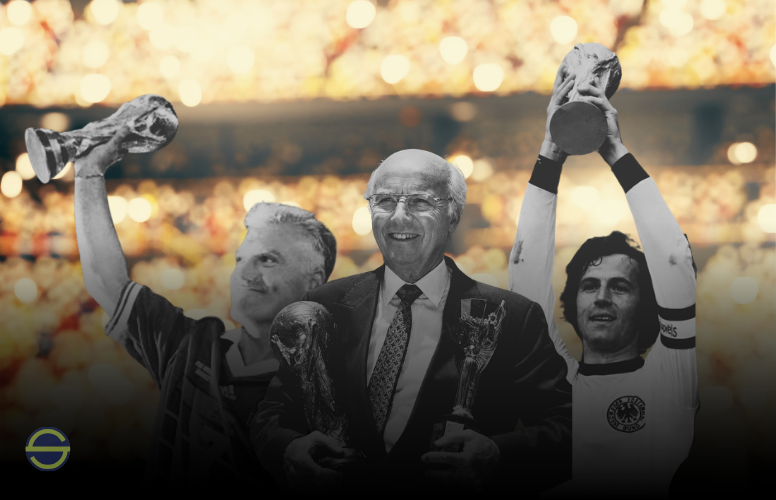
Winning the World Cup is football’s highest summit. To reach it as a player is enough to make a career immortal. But to return years later and win the same trophy from the touchline — in a suit, between substitution boards, tactical notes and the weight of an entire nation — belongs to a very different kind of story.
Because winning the World Cup as a player is physical. You run, collide, improvise and decide in seconds. Winning it as a coach requires another kind of endurance: choosing, convincing, explaining, managing disappointment, carrying expectation, and fitting a country’s dreams into the fragile atmosphere of a dressing room.
In the history of men’s football, only a few have completed both journeys at the very top.
Only three men have won the FIFA World Cup as both player and head coach: Mário Zagallo, Franz Beckenbauer and Didier Deschamps.
All three first met the trophy on the pitch.
Then, years later, they walked back to it from the touchline.
Mário Zagallo: The Quiet Intelligence Behind Brazil
Mário Zagallo’s story is not simply the story of a player becoming a coach. It is the story of Brazilian football finding a balance between romance and structure.
Zagallo won the World Cup as a Brazil player in 1958 and 1962. When people think of that era, the names that naturally come first are Pelé, Garrincha, Vavá and Didi. Zagallo is often mentioned more quietly beside them, but his role was deeply important. He played on the left, yet he was never just a traditional winger. He tracked back, covered space and helped protect the team’s shape. In modern football, that may sound ordinary. In Brazil’s footballing context at the time, it was significant.
In the 1958 final, Brazil beat Sweden 5-2, and Zagallo scored. But measuring his value only through the scoresheet would miss the point. His real importance was in what he represented: the collective intelligence that allowed Brazil’s great talents to function together.
That intelligence reached its peak in 1970.
Brazil did not arrive in Mexico with great players alone. They arrived with a great question: how could so many creative footballers play in the same team? Pelé, Jairzinho, Rivelino, Tostão and Gérson all had to exist inside one structure. Many great squads in football history have failed not because they lacked talent, but because they lacked balance.
That is where Zagallo’s work mattered. He did not simply give Brazil freedom; he built the structure in which that freedom could survive. Brazil won all six of their matches at the 1970 World Cup and claimed the trophy for a third time. Zagallo became the first person in history to win the World Cup as both player and coach.
His story reminds us of something simple but essential: great teams are not built only with great feet. They are built with great harmony.
Franz Beckenbauer: Authority Born from Inside the Game
Franz Beckenbauer’s World Cup story is one of the rare cases in which football found elegance and authority in the same figure.
In 1974, he was West Germany’s captain. The tournament was being played on home soil, expectations were enormous, and the final brought them face to face with Johan Cruyff’s Netherlands. The Dutch were reshaping football with the idea of “Total Football”. West Germany, by contrast, appeared more controlled, more patient and more ruthless.
Beckenbauer stood at the centre of that team. He helped redefine the libero role, turning it from a purely defensive position into one of the starting points of his team’s game. He carried the ball out of defence, read situations early and controlled the rhythm around him. His leadership was not only in the captain’s armband. It was visible in the way he governed the tempo of a match.
West Germany beat the Netherlands 2-1 in the 1974 final. Beckenbauer lifted the World Cup as a player.
His second World Cup triumph came in a very different form.
In 1990, he was West Germany’s head coach. At the tournament in Italy, he guided his team to the final, where they faced another giant World Cup story: Diego Maradona’s Argentina. Four years earlier, Argentina had beaten West Germany in the 1986 final. The 1990 final was not just a final; it was an unresolved chapter returning to the same stage.
West Germany won 1-0 in Rome. Beckenbauer became the second man, after Zagallo, to win the World Cup as both player and coach.
What makes Beckenbauer’s story so striking is the natural continuity between his intelligence as a player and his authority as a coach. Even on the pitch, he often seemed like more than a player — almost a future coach already directing the game from within it.
Didier Deschamps: The Cool Language of Winning
Didier Deschamps is the modern face of this exclusive group.
In 1998, he was France’s captain. As France won the World Cup on home soil, Deschamps was not the team’s most spectacular player. Zinedine Zidane became the final’s defining figure, Thierry Henry represented the new generation, and Lilian Thuram had already delivered one of the tournament’s great defensive stories. Deschamps was something else: the balance of the team.
His playing career is often described as “unspectacular”, but that word can be misleading. In major tournaments, unspectacular players are often the invisible skeleton of a winning side. Deschamps moved the ball simply, protected space, controlled rhythm and prevented the team from losing emotional balance.
France beat Brazil 3-0 in the 1998 final and won the World Cup for the first time. Deschamps lifted the trophy as captain.
Twenty years later, in 2018, he returned as France’s head coach. This time, he had a powerful generation at his disposal: Kylian Mbappé, Antoine Griezmann, Paul Pogba, N’Golo Kanté, Raphaël Varane and others. But great squads do not automatically win major tournaments. Sometimes, too many options become not an advantage, but a test.
Deschamps’ France in 2018 was not a team built to satisfy every romantic idea of football. But it was clear, disciplined and brutally effective. France knew what they wanted to be. They could allow opponents the ball, accelerate in transition, use their physical strength, and rely on individual quality at the right moments.
France beat Croatia 4-2 in the final and won their second World Cup.
Deschamps joined Zagallo and Beckenbauer as the third man to win the tournament as both player and coach.
His story shows that in modern football, coaching is not always about finding the brightest idea. Sometimes, it is about finding the right balance. As both player and coach, Deschamps represented the same principle: letting stars shine while keeping the team bigger than any individual.
Three Different Paths, One Shared Truth
Zagallo, Beckenbauer and Deschamps reached the same destination, but not by the same route.
Zagallo gave structure to Brazil’s attacking abundance.
Beckenbauer carried leadership from the pitch to the touchline.
Deschamps brought balance and discipline to the chaos of modern star power.
Their shared achievement is not only that they won the World Cup in two different roles. The deeper connection is that they did not merely play football; they understood it.
This is not the kind of achievement that can be explained by coincidence. The World Cup comes only once every four years, and for most great careers, it offers only one true opening. To seize it as a player is difficult enough. To return and reach the same summit as a coach requires a different profession, a different psychology and a different understanding of time.
That is why the list remains so short.
Many great players have become coaches. Many great coaches were once good players. But very few have stood at the very top of both worlds.
Football sometimes keeps its memory through goals. Sometimes through the image of a captain lifting the trophy. Sometimes through a coach standing quietly on the touchline after the final whistle.
Zagallo, Beckenbauer and Deschamps are three different faces of that memory.
One gave intelligence to Brazil’s creative chaos.
One turned German leadership into something almost imperial.
One taught France the cool, modern language of winning.
They touched the same trophy from two different lives.
And perhaps that is why one of the most exclusive clubs in World Cup history still has only three members.