
Franco Baresi Dies at 66: Farewell to Milan's Eternal No. 6
AC Milan and Italy legend Franco Baresi has died at the age of 66. We remember the quiet captain who transformed defending, stood by Milan through its darkest years and gave lasting meaning to the No. 6 shirt.
This article was originally written in English .
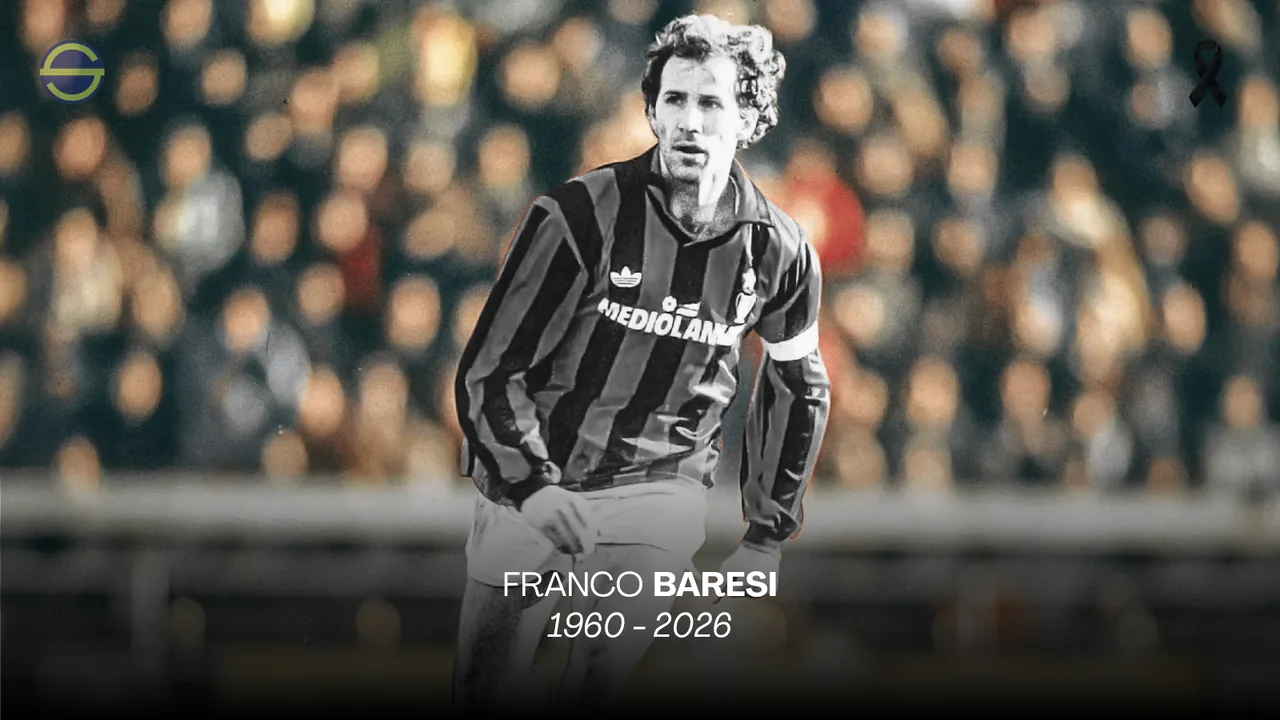
In football, some losses cannot be contained in a date. Certain figures remain part of the game long after their careers have ended. They reappear in a flag in the stands, in footage from an old match or in the perfectly timed step of a young defender.
Franco Baresi was one of those figures.
AC Milan announced on 31 July 2026 that its legendary captain had died at the age of 66. The club described him as “the heart and soul of Milan.” Those words captured the bond between Baresi and the Rossoneri. He represented not only the club's greatest years, but also some of its most difficult ones.
Milan's heart falls silent
One of Baresi's final major public appearances came at San Siro only a few months before his death. During the opening ceremony of the Milano Cortina Winter Olympics, he stood once again in the stadium he had defended for so many years.
The applause that night was not intended as a farewell. Today, however, the moment feels like one of the last occasions on which San Siro rose for its former captain.
Baresi was never a theatrical leader. He did not need to shout or make aggressive gestures to establish his authority. A few steps could reorganise the defence. He saw an opponent's pass before anyone else and guided his team-mates into the correct positions.
Some captains wear the armband. Others give it meaning. Baresi belonged to the second group.
The boy Inter turned away
Baresi's story began with one of football's small twists of fate.
As a young player, he attended a trial at Inter alongside his older brother Giuseppe. Inter kept Giuseppe but decided that Franco was not physically strong enough. The slender younger brother later joined Milan's academy.
Years later, Giuseppe Baresi would captain Inter and Franco Baresi would captain Milan. Two brothers raised in the same family would lead opposite sides of the Derby della Madonnina.
The boy Inter had rejected soon became the central figure in Milan's defence. He spent his entire professional club career with the Rossoneri. His journey began in 1977 and ended in 1997. For 20 years, he never wore another club's shirt.
The length of that commitment was not the only thing that made it special. Baresi did not stay simply because Milan were winning. He also stayed when they were struggling.
Milan were relegated to Serie B twice in the early 1980s. Baresi could have left, but instead helped the club return to the top flight. He later won six Serie A titles and three European Cups, while serving as Milan captain for 15 seasons.
His was not a story of loyalty to success. It was a story of loyalty to a club.
The quiet leader of the defence
Baresi was not a traditional centre-back who intimidated opponents with his physical presence. He was not especially tall and did not appear as imposing as some defenders of his era. His greatest strength was his ability to read the game before his opponent.
He recognised where the ball was going, which run an attacker would make and when the defensive line needed to step forward. Often, he did not even need to make a tackle. He removed the danger before it could develop.
Baresi helped turn the libero role into much more than a defensive position. After winning the ball, he started Milan's attacks, controlled the distances between his team-mates and moved into midfield when necessary.
The defensive unit he formed with Paolo Maldini, Alessandro Costacurta and Mauro Tassotti became one of the finest in football history. Arrigo Sacchi's high defensive line and the 58-match unbeaten league run under Fabio Capello could not have functioned in the same way without Baresi's intelligence.
Watching him was a reminder that defending was not only about physical challenges. It was also the art of timing, positioning and making the correct decision.
Maradona in the No. 6 shirt
Sometimes the best evidence of a player's greatness comes not from statistics, but from the people who faced him. Diego Armando Maradona was one of those people.
A story repeated for many years says that Michel Platini once told Maradona, then new to Serie A, to wait until he faced Baresi. Platini knew how much Maradona enjoyed dribbling and believed the Milan captain would present a very different challenge.
Some details of the story have changed over time, so it should not be treated as a precise historical record. The respect between Maradona and Baresi, however, was real.
The clearest image of that respect came in 1989. After a match between Napoli and Milan, Maradona exchanged shirts with Baresi. Napoli's No. 10 immediately pulled Milan's No. 6 over his own shirt.
Speaking to an interviewer in the tunnel, Maradona said that the shirt belonged to a great player. He described Baresi as a benchmark for defenders and said he would keep the shirt for the rest of his life.
On one side stood one of football's freest No. 10s. On the other was the No. 6 who had changed the boundaries of defending. One brought entire stadiums to their feet whenever the ball reached him. The other knew where it would go before anyone else.
Baresi later admitted that he did not sleep easily before facing players such as Maradona, Platini, Zico and Careca. He considered Maradona one of his greatest opponents and respected both his leadership and his refusal to complain despite the tackles he received.
Great players often recognise each other's value before anyone else.
The final, 25 days after surgery
One of the clearest examples of Baresi's character came at the 1994 World Cup.
He injured his knee during Italy's group-stage match against Norway and required surgery. His tournament appeared to be over. Only 25 days later, however, Baresi returned for the World Cup final against Brazil.
He did not return for a brief appearance. He played for 120 minutes, including extra time. He did not look like a footballer who had recently undergone surgery. He organised Italy's defence with his usual calmness.
Baresi missed his penalty in the shootout and could not hide his tears at the end of the match. That image was replayed for years, but his performance that night was about much more than one missed kick.
The real story was that a captain who had been on an operating table 25 days earlier returned for the biggest match in football and kept his team standing for 120 minutes.
The legacy of the No. 6
When Baresi retired in 1997, Milan retired his No. 6 shirt. He became the first player in the club's history to receive that honour.
From that moment, Milan's No. 6 represented more than an unused squad number. It came to symbolise staying during difficult times, refusing to place yourself above the team and leading through actions rather than words.
Paolo Maldini's tribute after Baresi's death also captured that legacy. Maldini remembered how Baresi had protected him as a child, guided him as a young player and continued to inspire him as an adult.
Baresi's career can be summarised in numbers: 20 years, 15 seasons as captain, six league titles, three European triumphs and 81 appearances for Italy.
But the part of football we love cannot always be contained in numbers.
If we remember Baresi only for his trophies, we cannot understand why he stayed when Milan fell into Serie B. If we look only at defensive statistics, we cannot explain why Maradona wore his shirt after a match. If we watch only the missed penalty, we cannot see the fight required to return for that final.
Franco Baresi will now be spoken about in football's past tense. Milan's No. 6, however, will never belong entirely to the past.
Some players play football. Others become part of its memory.
Franco Baresi was one of the latter.


