Premier League’s Late-Season Reset: Carrick and De Zerbi
The Premier League’s final stretch has shown how quickly a managerial change can alter a club’s direction. Michael Carrick has restored control at Manchester United, while Roberto De Zerbi has brought belief back to Tottenham — two resets with very different stakes.
The final stretch of the Premier League season has become more than just a points race for some clubs. It has also shown how a well-timed managerial change can reshape the direction of an entire campaign.
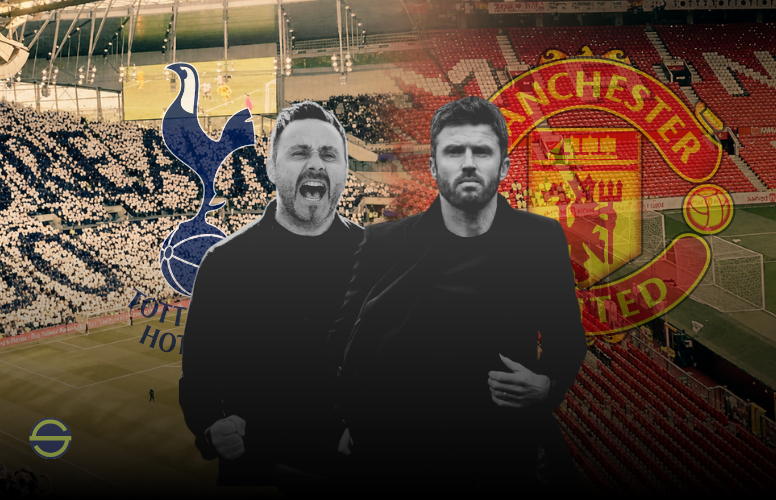
Manchester United and Tottenham both changed managers to stop a poor run of form. At United, Michael Carrick replaced Ruben Amorim, while at Tottenham, Roberto De Zerbi came in for Igor Tudor.
Both changes have produced a positive impact in a short period of time. However, these two stories should not be judged on the same level. Carrick’s Manchester United have now secured Champions League qualification. De Zerbi’s Tottenham, despite showing a strong reaction, are still fighting to stay in the Premier League.
That is why these two examples show how managerial changes can lead to different outcomes in football: one has reached its target, while the other is still fighting the most important battle of its season.
Carrick’s Manchester United: The Return of Control
Michael Carrick’s impact at Manchester United has mainly been felt through the team’s calmer and more controlled structure. After a difficult and inconsistent period under Amorim, United began to look like a side with a clearer game plan, a stronger dressing-room connection and a more reliable approach to big matches.
Carrick’s start also set the tone for this change. His first match was the Manchester derby, and he made a powerful statement by beating title-chasing Manchester City 2-0 at Old Trafford. It was not only a strong beginning; it was also an early sign that the players were ready to respond to their new manager and that United could compete again under pressure.
The numbers that followed supported that impression. Under Carrick, Manchester United have recorded 10 wins, 2 draws and 2 defeats in 14 matches. That run helped United move away from uncertainty and return to Champions League level.
United’s latest match, a 3-2 win over Liverpool, became one of the clearest signs of this transformation. Beating a major rival like Liverpool was not just about three points. It showed that Carrick’s United can compete in big games, handle pressure and complete the main target of the season.
With that result, Manchester United have now secured Champions League qualification. Considering the uncertainty and poor form earlier in the season, that should be seen as a clear achievement for Carrick.
One of Carrick’s biggest strengths has been his understanding of the club. His Manchester United background, more natural communication with the players and calm leadership style have helped reduce pressure around the squad. The players appear more comfortable under him, training has become shorter but more intense, and communication inside the dressing room looks clearer.
Modern football management is no longer only about drawing tactical plans. Gaining the players’ trust, keeping the team mentally strong during difficult periods and bringing the energy inside the club back to the right place are just as important as the on-pitch plan.
In that sense, Carrick has given United exactly what they needed: calmness, trust and control.
The Question Around Carrick Has Changed
For Manchester United, the managerial change has worked in the short term. That is no longer difficult to argue. The team have secured Champions League qualification and entered the final part of the season in a much stronger position.
But for Carrick, the question is no longer, “Has he turned United around?” That stage has passed. The new question is: can this success become a long-term project?
At a club like Manchester United, a few good results or a short-term rise may not be enough. If Carrick is to become a permanent managerial figure, the team will need more than results. They will need a sustainable football identity.
Attacking variety, midfield balance, consistency against lower-profile opponents and whether the players can maintain the same level of energy will all be key points in that process.
Still, the current picture is clear. Carrick has lifted Manchester United after the Amorim period, taken them back to Champions League level and positioned himself as a strong managerial candidate inside the club.
De Zerbi’s Tottenham: Hope Has Returned, But the Danger Is Not Over
Roberto De Zerbi’s arrival at Tottenham happened in a much more fragile atmosphere. After replacing Igor Tudor, the Italian coach inherited not only poor results, but also a squad low on confidence and feeling the pressure of the relegation battle.
For Tottenham, the target was not to move closer to the top of the table. The mission was much more urgent and basic: to stay in the Premier League.
That is why De Zerbi’s impact needs to be judged more cautiously than Carrick’s at Manchester United. United have already completed their target. Tottenham are still trying to complete theirs.
De Zerbi’s first match ended in a 1-0 defeat away to Sunderland. That result showed clearly how difficult the job was. But Tottenham’s reaction afterwards was important. In De Zerbi’s first four matches, Spurs recorded 2 wins, 1 draw and 1 defeat. They drew against Brighton and then won away at Wolves and Aston Villa.
The 2-1 away win against Aston Villa was especially valuable. Villa are one of the stronger and more competitive sides in the league, so winning at Villa Park mattered not only for the table, but also psychologically.
That victory showed that Tottenham can still fight, that the players are responding to their new manager and that the team can enter the final weeks of the season with stronger belief.
De Zerbi’s Biggest Impact: The Players Believe Again
De Zerbi’s influence at Tottenham has not only been about results. The team have started to look braver, livelier and more determined. The energy on the pitch has changed; Tottenham no longer look like a side only reacting to matches, but one that is willing to take more responsibility within them.
Conor Gallagher’s comments after the Aston Villa match also captured that change well. Gallagher said the players trust their new manager, that De Zerbi gives them confidence and that he is starting to bring the best out of them. For a team under relegation pressure, that is a crucial detail.
In moments like this, belief can be just as important as tactics. When players believe in the manager, accept the plan and show courage again on the pitch, it can make a real difference in a survival race.
De Zerbi has brought that feeling back to Tottenham. But it is not yet a completed success.
Tottenham Are Still in the Fight
Tottenham’s away win against Aston Villa was extremely valuable. But Spurs are still fighting to stay in the Premier League. That means De Zerbi’s impact is positive, but not yet definitive.
The team look better, the players seem more confident and the recent results have given Tottenham breathing space. But the fragility they have shown throughout the season will not disappear after only a few matches. The remaining fixtures will show whether De Zerbi has created only a short-term morale boost or built a structure that can truly move Tottenham to safety.
That is why the fairest description for De Zerbi is this: he has given Tottenham hope, but the story is not finished yet.
Two Managers, Two Different Stages
The examples of Carrick and De Zerbi show that managerial changes can still be powerful decisions in football. But these two changes are not at the same stage.
Carrick has reached the target at Manchester United. The team stopped their poor run, secured Champions League qualification and now have the chance to finish the season in a much stronger position. The 2-0 win in the Manchester derby was the powerful start of that process, while the 3-2 victory over Liverpool has become one of the symbolic results of the Carrick era.
De Zerbi, meanwhile, has created a strong reaction at Tottenham. Despite losing his first match, he has recorded 2 wins, 1 draw and 1 defeat in his first four games. The 2-1 win away to Aston Villa showed that the team believes again. But because Tottenham are still fighting to stay in the Premier League, this success is not complete yet.
One is a recovery story that has already reached its target. The other is a survival story still being written.
Conclusion: A Well-Timed Managerial Change Can Reshape a Season
In the Premier League, managerial changes sometimes create only a short-term lift. But when the right profile meets the right squad at the right moment, it can truly change the direction of a season.
At Manchester United, Carrick brought the calmness and control the club needed. As a result, United have secured Champions League qualification. The record of 10 wins, 2 draws and 2 defeats in 14 matches shows that his impact is not only emotional; it has also been clearly reflected in the results.
At Tottenham, De Zerbi has restored belief to a squad that had lost confidence. A process that began with defeat against Sunderland has moved in a more hopeful direction through a draw with Brighton and away wins against Wolves and Aston Villa. But for Spurs, the final word has not yet been written.
Carrick’s story currently looks like a successful one. De Zerbi’s story is still ongoing.
And perhaps that is the clearest way to understand managerial changes: sometimes a new manager does not only steady a team; he can reshape the club’s destiny at the end of a season.